“You shouldn’t need a handbook if you’re reading tarot properly.”
I’ve come across this so many times when teaching tarot. The idea floats through the tarot world so casually that many people absorb it without even consciously agreeing to it. It’s rarely stated outright. It’s simply implied — through tone, through comparison, through the subtle pressure to appear a naturally intuitive.
And yet, in my experience, this belief is one of the most common sources of doubt among genuinely thoughtful, sincere tarot readers: those who care deeply and want to get it right.
I’m thinking about people drawn to tarot as a way of understanding themselves.
As a mirror for the question “Who am I?”
As a companion in the search for meaning and direction.
When these readers reach for a guidebook and feel a flicker of embarrassment — “I should know this by now” — something important is happening. Their attention has turned inward, but not in a helpful way. Instead of curiosity, self-surveillance appears. Instead of exploring understanding, there is a self-conscious pressure to perform.
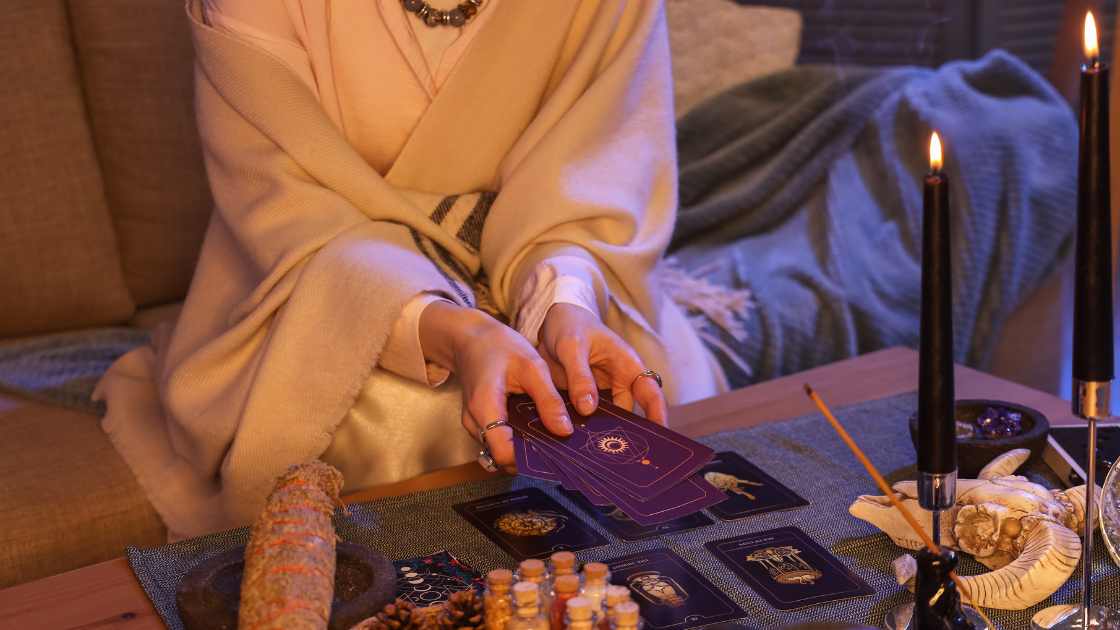
The truth is, it’s okay to use the handbook.
Here’s the thing most introductions to tarot don’t say clearly enough:
Tarot is not a test of psychic ability.
It’s a language you can learn.
No one would expect to learn a language without dictionaries, guides or conversational partners. Fluency is achieved through use, repetition, reference and relationship. We don’t shame ourselves when we check the meaning of a new word — we recognise that this how understanding deepens and grows.
Yet with tarot, many people assume that they should just be able to pick up a deck and do it; that needing support means they lack natural intuition, and will never be able to read fluently.
Over time, this belief quietly distorts the experience of reading. Because if you believe you should already know intuitively what every cards means, every moment of uncertainty starts to feel like failure.
Pauses feel like weakness. Confidence erodes not because insight is absent, but because it’s as if your permission to learn has been withdrawn.
Readings become hesitant. Card meanings start to feel inconsistent or elusive. The tarot deck — once a source of fascination — just becomes something else you have to “get right.”
I’ll say it again: it’s absolutely okay to use the handbook.
Understanding comes from familiarity. It doesn’t just come from memorising meanings though. It comes from learning how to work with the cards in a way that supports your understanding and develops your natural intuitive skills.
When you allow yourself to look things up without judgment, something subtle but powerful shifts. The handbook stops being a prop and becomes a collaborator. Subtly, over time, the handbook meanings become no longer rules to obey, but reference points that guide your interpretation while leaving you space for your imagination.
This is where tarot begins to do its deeper work.
Not by making brilliant predictions.
Not by proving your psychic ability.
But by creating a meaningful dialogue between your conscious thoughts and your unconscious wisdom.
If you’d like to explore how this belief may have shaped your own relationship with tarot, try journaling with this prompt: “When I reach for the handbook, it makes me feel that I’m…”
You can complete the sentence as many times, in as many ways as you need to.
If you want to go further, you can continue with: “If I released that assumption, I might feel more…”
Let the answers surprise you. Notice what changes — tarot becomes empowering when we stop trying to prove that we have intuition, and start trusting the processes that actually build it.
For many Spiritual Explorers, tarot is not simply a tool. It is a way of creating their path in life — a symbolic landscape in which questions of purpose, identity and direction can be explored safely and honestly.
In that context, the goal is not mastery for its own sake.
The goal is building a relationship between the tarot and our own unconscious, untapped wisdom.
Tarot is at its most inspiring when we stop trying to demonstrate — to ourselves or anyone else — how intuitive we are and start practicing the actions that actually build intuition, connection and awareness: attention, curiosity, patience and the willingness to explore understanding and meaning — even when it means going back to the handbook.
And perhaps this is the deeper myth worth questioning:
That understanding should arrive fully formed, without effort, without support, and without doubt or hesitation.
The truth is, tarot will always meet us where we are — not where we think we ought to be.



0 Comments